Cards or a Jigsaw for a Shared Afternoon?
Cards or a jigsaw for a shared afternoon? Choose the activity that fits your group’s attention, numbers and stopping point, for a more comfortable gathering.
Cards or a jigsaw for a shared afternoon? The answer depends less on which activity is better than on how people want to share their attention. A card game gives a group repeated turns and clear pauses; a jigsaw keeps a common task open while conversation comes and goes.
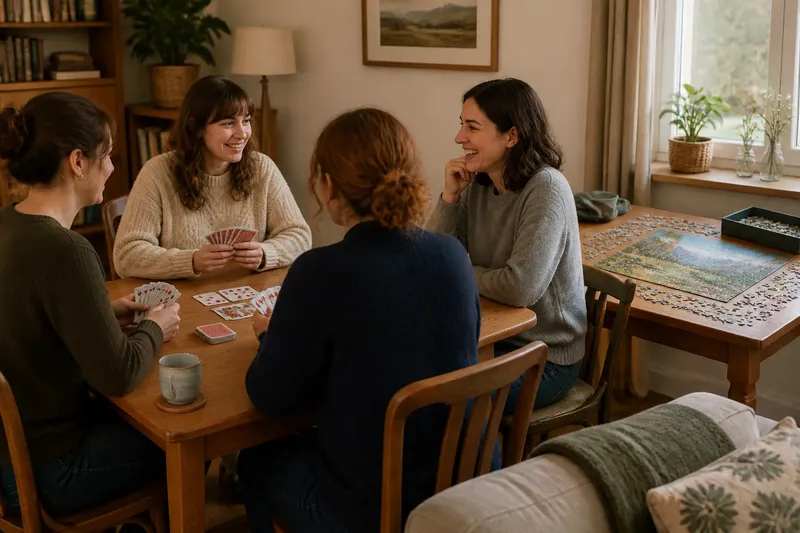
Imagine a clearly hypothetical gathering: Mara invites three friends over on a Saturday afternoon. One friend expects to leave before tea, another likes a little friendly competition, and the others would rather chat than learn a complicated game. Mara has a familiar deck of cards and a half-finished landscape jigsaw. Her choice will shape the feel of the room, not just fill the table.
Cards or a jigsaw
Mara first considers how attention will move. Cards usually ask players to notice a hand, remember a rule or watch what someone else does. Even a relaxed game creates moments when people need to look up and take part. A jigsaw asks for a different kind of attention: someone can search for a piece, stop to listen, then return without needing to catch up on a sequence of turns.
That distinction is like choosing between a conversation round a table and a shared noticeboard. The cards keep inviting each person back into the same exchange; the puzzle lets people contribute at the edges. Neither is automatically more social. The useful question is whether the group wants to talk together in bursts or alongside one another at an easy pace.
Mara notices that her friends have different appetites for concentration. She chooses a simple card game, but keeps the jigsaw on a side table as an optional activity before and after play. This gives the gathering a clear centre without asking every guest to enjoy the same level of involvement.
Match the group size
A card game tends to work best when the number of players suits its rules. With too many people around a small game, turns can feel distant; with too few, a game designed for a larger group may lose its rhythm. Check the player range printed on the rules or choose a familiar game whose turn pattern everyone understands.
A jigsaw is more flexible about numbers, but table space matters. Several people can look for pieces at once, though crowding can make it awkward to reach the image or sort the pieces. A broad table or a board that can be moved aside helps. People can also drift in and out without interrupting anyone’s turn.
For Mara’s four guests, the card table has room for everyone, while the puzzle would make a comfortable side activity for one or two people at a time. If a larger group arrives, the jigsaw can absorb extra hands more easily than a game with a fixed turn order. If the gathering is small and everyone wants active interaction, cards may hold attention more evenly.
Notice the stopping point
Cards naturally divide an afternoon into rounds. A round ends, players can decide whether to continue, and someone leaving has a clear moment to step away. That makes cards useful when arrival and departure times differ, or when the group wants a playful activity that does not need to remain on the table.
A jigsaw has a softer boundary. It may be easy to pause, but there may be no satisfying finish before guests go. The puzzle can remain in place for another day, provided the table is not needed and loose pieces can be kept together. A portable board or shallow tray makes that pause simpler; it also lets the host move the activity without dismantling it.
Mara knows one friend must leave early, so she suggests playing a single short round before deciding what comes next. The friend can leave at the round’s end without breaking the group’s concentration. The others can then continue with another round or turn to the jigsaw. The observable result is a natural departure point, rather than a guest leaving halfway through a shared task.
Set the room’s rhythm
Think about sound and conversation, too. A card game may bring more laughter, questions and commentary, especially when the rules are new or the competition is lively. A jigsaw tends to support quieter talk, though searching for pieces can still prompt small collaborations. The room’s mood often follows the activity’s demands.
Before choosing, Mara asks herself a few practical questions:
- Do guests want turns, or would they rather join and leave the activity freely?
- Will everyone be comfortable learning or recalling the game’s rules?
- Is there enough table space for the chosen activity and drinks?
- Does anyone need to leave at a particular point?
- Would the group welcome a clear finish, or a task that can stay unfinished?
These are not rules for every gathering. They are prompts for matching the activity to the people who are actually coming. If conversation is the main event, leave enough room for it. A game with many rules can turn a casual visit into a lesson; a puzzle spread across the only table can make refreshments inconvenient.
Which suits this afternoon?
Are cards better for a lively group?
They can be, if guests enjoy taking turns and sharing a common focus. Pick a familiar, straightforward game when the group would rather begin talking than spend time learning rules.
Does a jigsaw suit people who arrive late?
Often, because a newcomer can look for pieces without waiting for a round to end. Leave room for them to see the picture and reach the work without interrupting someone else.
What if guests want different things?
Offer one activity as the main invitation and keep the other available if space allows. People can then join the card game, work on the puzzle or simply talk without being assigned a role.
How should a group choose between them?
Start with the afternoon’s likely shape: shared bursts of attention favour cards, while a flexible, ongoing task favours a jigsaw. If the group is uncertain, begin with the activity that is easiest to pause and change.
Let the choice stay light
Mara’s invented afternoon begins with a short card round. The early-departing friend leaves at a natural break; the remaining guests choose whether to play on. One of them moves to the landscape puzzle, and another joins after finishing a conversation. The result is not a perfect schedule but a gathering with more than one comfortable way to take part.
For a shared afternoon, cards or a jigsaw can both work well when the activity matches the group’s attention, size and stopping point. You do not need to settle the whole afternoon in advance. A clear invitation, an easy pause and enough space for people to choose their level of involvement can make either option feel like a welcome pastime rather than an obligation.