A First-Time Potluck with a Clear, Low-Fuss Plan
A first-time potluck is easier to host when guests know what to bring, when to arrive and how the shared meal will work from the start.
What should you ask guests to bring, and how do you keep a shared meal relaxed when people arrive at different times? A first-time potluck works best when you make a few decisions before sending the invitation: what kind of meal you are having, what you will provide, how guests can claim a contribution and whether the food needs to be ready at a particular time.
The host’s job is not to assign every dish or chore. It is to make the arrangements clear enough that guests can choose a useful contribution without guessing. Think of the plan as a tablecloth: it gives the meal a shared shape, but it should not stop anyone from bringing a dish that feels like their own.
Choose the meal shape
Start by deciding what sort of gathering you are hosting. The right arrangement depends on the people, the room and the time of day. A relaxed afternoon meal has different needs from dinner for a group that expects to sit down together.
- For a casual drop-in: Make the event an open window rather than a single arrival time. Choose food that can be served in small portions over a while, such as savoury tarts, bread, dips, fruit and biscuits. This fits guests with changing schedules, but it works best if you do not promise a formal toast or a meal served all at once.
- For a sit-down meal: Set one arrival time and a clear serving time. Ask guests to bring dishes that can wait briefly or be served at room temperature. This suits a group that wants to eat together, because late arrivals are less likely to disrupt a shared course.
- For a mixed group with children or busy schedules: Use a broad arrival window and a loose central meal time. Keep a simple, familiar option available and let guests know that people may eat in stages. This gives families some flexibility without making anyone wonder when the main food will appear.
- For a small group that enjoys cooking: You can invite people to bring a dish that needs a last-minute finishing touch, but confirm what equipment and counter space are available. This is a good fit when guests know one another and can coordinate easily; it is less suitable if several people would need the same oven or hob.
Decide whether you are providing the main dish or asking the group to contribute across the meal. For a first gathering, providing one reliable anchor—such as a large tray of baked pasta, a pot of soup or a substantial salad—can make the menu easier to balance. If you prefer a fully shared meal, say so plainly and suggest broad categories rather than leaving everyone to bring whatever occurs to them.
Set expectations clearly
An invitation should answer the practical questions guests may hesitate to ask. Give the date, the arrival window, the address, the rough eating time and whether people should bring food, drinks, serving pieces or nothing at all. Mention whether the gathering is indoors, outdoors or likely to move between the two.
Keep the wording warm and direct. “Come any time after four; we’ll put food out around five” gives people more help than “Drop by in the afternoon”. If the event has one shared start, say that too. A guest who knows the plan can decide whether the timing suits them without sending a chain of follow-up messages.
Tell guests what you are already covering. For example, you might provide the main dish, plates, glasses, water and tea, while inviting guests to choose a side, salad, dessert or non-alcoholic drink. Be specific about whether you want a dish for everyone to share or a small contribution for a particular dietary need.
Ask about dietary restrictions in the invitation, but do not ask a guest to explain private medical details to the group. You can invite them to message you directly. If you cannot accommodate a particular need, say so kindly and discuss what would make the meal workable; for serious allergies or other health concerns, the person affected is best placed to advise on what is safe for them.
Coordinate dishes without fuss
Guests often need a little structure, not a detailed menu assignment. Offer a short list of categories and ask people to reply with their choice. A shared message thread or simple sign-up sheet can show what has already been claimed. Avoid asking everyone to add a dish to a long list of possibilities unless you are willing to keep track of it.
A useful starting list might include:
- A main dish, if the host is not providing one.
- A salad or vegetable side.
- A filling side such as bread, rice or potatoes.
- A dessert or fruit.
- Drinks, with a non-alcoholic option included.
- Ice, napkins or another small practical item, if needed.
Do not treat these as equal assignments. One guest may bring a large dish; another may bring fruit or a bottle of cordial. Make clear that a contribution can be bought rather than cooked. That small permission matters: it keeps the invitation focused on sharing a meal, rather than judging who has the most time or kitchen confidence.
Ask for a brief description of each dish, including whether it is vegetarian or contains common allergens if the guest knows. You do not need to turn the invitation into a food-label form. A name such as “chickpea and tomato salad” is already more useful than “salad”, and a note that a dish contains nuts can help guests make an informed choice.
Say whether guests should bring a serving spoon, knife or dish label. If you have enough serving pieces at home, tell them not to worry about equipment. If you would like the dish to arrive ready to serve, say that; if you can make room for a cold dish that needs plating, say that instead.
Plan for staggered arrivals
When guests cannot all arrive at once, separate the arrival time from the moment food is served. Choose a broad window for people to come in, then name a point when you will put out the main spread. This lets early arrivals settle in without making later guests feel that they have missed the whole event.
For a drop-in gathering, put out food that remains appealing without constant attention. Bread, dips, savoury bakes, cut vegetables and sturdy salads can often be offered gradually. Keep more delicate items chilled until needed, and avoid building the whole menu around dishes that must be eaten hot at the same moment.
For a shared meal with a central serving time, ask guests to tell you if they expect to arrive after it. You can then decide whether to hold back a portion or make the meal more flexible. A late guest should not be left to guess whether they should eat before coming or expect a full plate on arrival.
Picture a host expecting six friends across a two-hour window. They plan a tray of vegetable lasagne for the middle of the gathering, ask one friend for bread and another for a salad, and tell everyone that fruit and biscuits will stay out for people who arrive later. The likely result is a meal with a clear centre, while late arrivals can still join without interrupting the first group.
Choose a simple welcome that does not keep you tied to the door. Put coats somewhere obvious, set out water and glasses, and let guests know where to leave their dish. If someone arrives while you are serving food, a visible note or a friend who knows the layout can help them find their way in.
Make the table workable
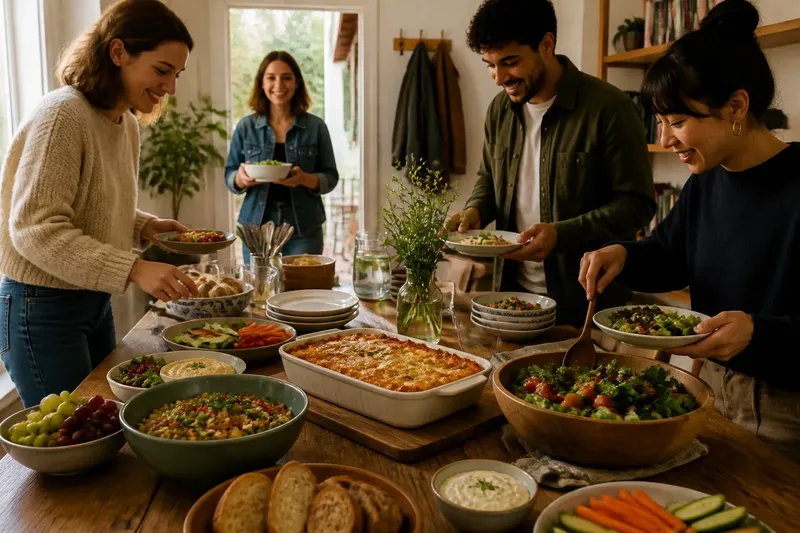
Before the gathering, clear a place for dishes to land. The kitchen counter, a side table or a sturdy board on a dining table can serve as a temporary buffet. Keep plates and cutlery together at one end, then leave room for guests to move along the food without reaching across one another.
Check what you already own: serving spoons, tongs, a bread knife, trivets, bowls and a jug for water. If several guests are bringing food in containers, have a few spare plates ready for anything that needs transferring. You do not need matching crockery or a decorated spread; clear labels and a sensible layout help more than elaborate styling.
For food that needs to stay hot or cold, ask the person bringing it how they plan to transport and serve it. Follow the food’s packaging and local food-safety guidance, especially for dishes containing meat, dairy, seafood or eggs. When uncertain, choose a safer serving arrangement or ask the guest to bring a dish that does not depend on delicate temperature control.
Set aside a small space for bags, coats and empty containers. Tell guests whether they should take their own dish home at the end, and keep a pen and scraps of paper nearby if you want to mark containers. This prevents the practical details from taking over the table where people are trying to eat.
What fits your gathering?
Should the host provide the main dish?
It is often the simplest choice for a first potluck because the host can set the meal’s centre and invite guests to fill in the sides. If you would rather share the main course too, make that explicit and ask one person to coordinate the choices so the group does not arrive with several similar dishes.
What if a guest does not cook?
Tell them that bought food, fruit, bread or drinks are welcome. A contribution is a way to take part, not a measure of cooking skill, and a clear invitation prevents a guest from feeling that they must prepare something elaborate.
How should guests handle dietary needs?
Invite guests to contact you privately about what they can eat, then share only the practical information the group needs. Keep ingredients or packaging available where possible, but do not present a dish as safe for someone unless its ingredients and handling are known to them.
What if someone arrives after the meal?
Tell them in advance whether food will still be available and what you can realistically hold back. For a casual gathering, set aside a portion or keep a few suitable items back; for a timed meal, be kind but clear that the shared serving will happen at the stated time.
Keep hosting light
Do the small preparation that reduces interruptions, then leave room for conversation. Put out the serving pieces, clear a place for incoming dishes and decide where rubbish and recycling go. You do not need to clean as guests eat or arrange every plate yourself.
If a dish arrives without a serving utensil, offer one of your own. If the menu has a gap, use what is already available rather than making a guest feel responsible. A potluck is a shared meal, not a promise that every category will be represented in perfect balance.
At the end, thank people for bringing what they could and give them an easy way to collect their containers. The most useful first-time potluck plan is the one that makes the timing, food and small responsibilities visible before guests arrive. Use that simple structure to host a gathering that feels shared, even when everyone’s contribution and arrival time differ.